
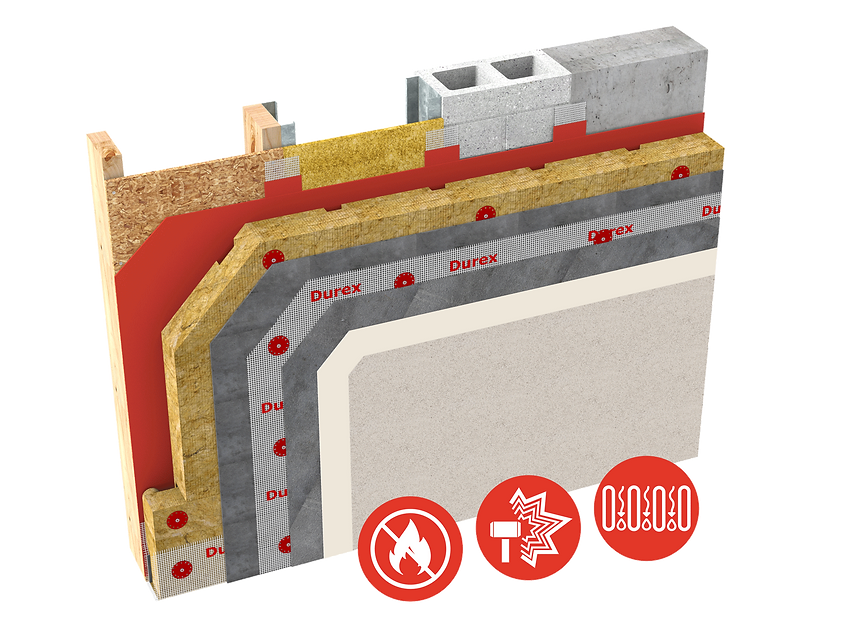
Typical Non-Combustible EIFS Wall Assembly
A non-combustible EIFS system with mineral wool consists of several layers installed in sequence to ensure proper performance.
Key components include:
-
Substrate and Water-Resistive Barrier (WRB)
The system begins with exterior sheathing covered by a WRB that protects the structure from moisture infiltration while allowing vapor permeability. -
Mineral Wool Insulation Board
High-density mineral wool insulation boards are mechanically fastened or adhesively attached to the substrate. Mineral wool is naturally non-combustible, vapor-permeable, and dimensionally stable. -
Reinforced Base Coat
A polymer-modified base coat is applied over the insulation and embedded with fiberglass reinforcing mesh. This layer provides impact resistance and structural strength. -
Primer Layer
A primer helps ensure proper adhesion and uniform absorption before the finish coat is applied. -
Acrylic or Mineral Finish Coat
The final textured finish provides color, weather resistance, and the architectural appearance of traditional stucco.
Fire Performance and Code Compliance
One of the main advantages of using mineral wool insulation in EIFS is its exceptional fire resistance. Mineral wool is manufactured from natural stone fibers and is classified as non-combustible, meaning it does not contribute to flame spread.
Because of this property, mineral wool EIFS systems are often specified in buildings where fire safety is critical, including:
-
Multi-unit residential buildings
-
Mid-rise and high-rise construction
-
Schools and healthcare facilities
-
Urban developments with strict fire separation requirements
These systems can be designed to meet Canadian fire testing standards such as CAN/ULC S114 for non-combustible materials.

